
Publications
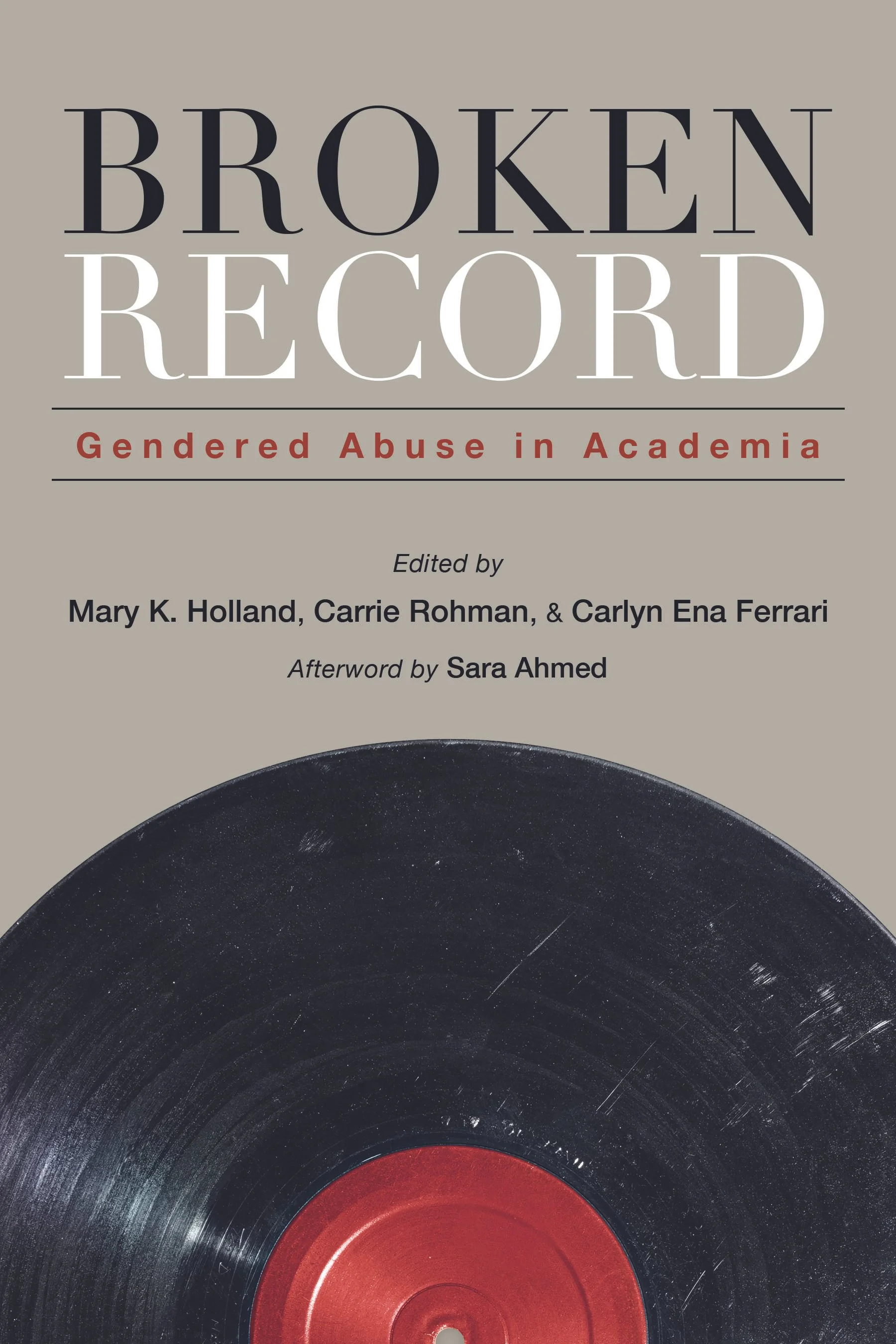
Broken Record: Gendered Abuse in Academia
Edited by Mary K. Holland, Carrie Rohman & Carlyn Ena Ferrari
(SUNY Press, 2025)
A landmark volume documenting the scope and insidiousness of gendered abuse in academia, revealing the limits of institutional redress, and sharing hard-won strategies for change.
Broken Record brings together narratives of gendered abuse in academia from across disciplines, at every career stage, around the United States and the world. Individually and collectively, contributors describe harrowing experiences of bullying, mobbing, harassment, and assault in a range of institutional spaces, including classrooms, offices, library stacks, conferences, interviews, and out on field research. Their abusers are teachers, mentors, students, colleagues, chairs, administrators, and even representatives of the very offices tasked with protecting them. Beyond using storytelling to expose the ubiquity of abuse, these writers also theorize its causes and proffer strategies for resistance and healing. With an afterword by Sara Ahmed, author of the groundbreaking Complaint!, Broken Record forms its own powerful collective-a chorus of nearly fifty academics with highly varied yet strikingly consistent narratives, united in a clarion call for change.
"As the editors hope and intend, this volume functions as a complaint collective. In their specificity and range, the essays cast light on many corners of academe, elucidating patterns of harassment and the blocking of efforts to prevent or redress harm. Although the essays document diabolically successful campaigns to isolate women academics and demonstrate the fragile bonds that hold whistleblowers together, the volume also provides the context necessary to understand the pervasiveness and nuances of harassment, as well as the processes that leave those who complain open to doubt and discrediting." — Leigh Gilmore, author of The #MeToo Effect: What Happens When We Believe Women


Do Not Separate Her from Her Garden: Anne Spencer’s Ecopoetics
By Carlyn Ferrari
(University of Virginia Press, 2022)
Anne Spencer was a pioneering African American poet, teacher, civil rights activist, and librarian at the all-Black Paul Laurence Dunbar High School in Lynchburg, Virginia. She was also an important member of the group of intellectuals known as the Harlem Renaissance. As a civil rights activist, Spencer worked in association with James Weldon Johnson and rubbed shoulders with Langston Hughes, Thurgood Marshall, and Dr. Martin Luther King Jr.
Drawing primarily on unpublished, undated poetry and prose, Do Not Separate Her from Her Garden represents a long overdue reassessment of an underappreciated literary figure. Employing ecopoetics as an analytical framework, Carlyn Ferrari recenters Spencer’s archive to cut to the core of her artistic ethos. Not only does this book resituate Spencer in the pantheon of American women of letters, but it uses her environmental credo to analyze works by Alice Walker, Zora Neale Hurston, and Dionne Brand, positioning ecocritical readings as a new site of analysis for Black women’s writings.
“A major contribution to studies of Anne Spencer specifically and to American literary and cultural criticism more broadly. Ferrari has engaged carefully with all the extant critical work in the field and pushed the level of scholarship to new heights. This book will prove of immense value to readers with an interest in the Harlem Renaissance and civil rights movements and to poetry readers, social historians, and cultural critics alike.” - Aldon Lynn Nielsen, The Pennsylvania State University, author of The Inside Songs of Amiri Baraka
Essays and Articles
“(Re)Making Generations: Gayl Jones’s Corregidora and Black Women’s Ecologies”, ISLE: Interdisciplinary Studies in Literature and Environment, 2025.
“What My Christian High School Taught Me About Being a Black Girl.” Religion Dispatches. June 3, 2021.
“You Need to Leave Now, Ma’am.” The Chronicle of Higher Education. September 8, 2020.
“On Black Women’s Ecologies.” Black Perspectives, published by the African American Intellectual History Society (AAIHS), June 2020.